
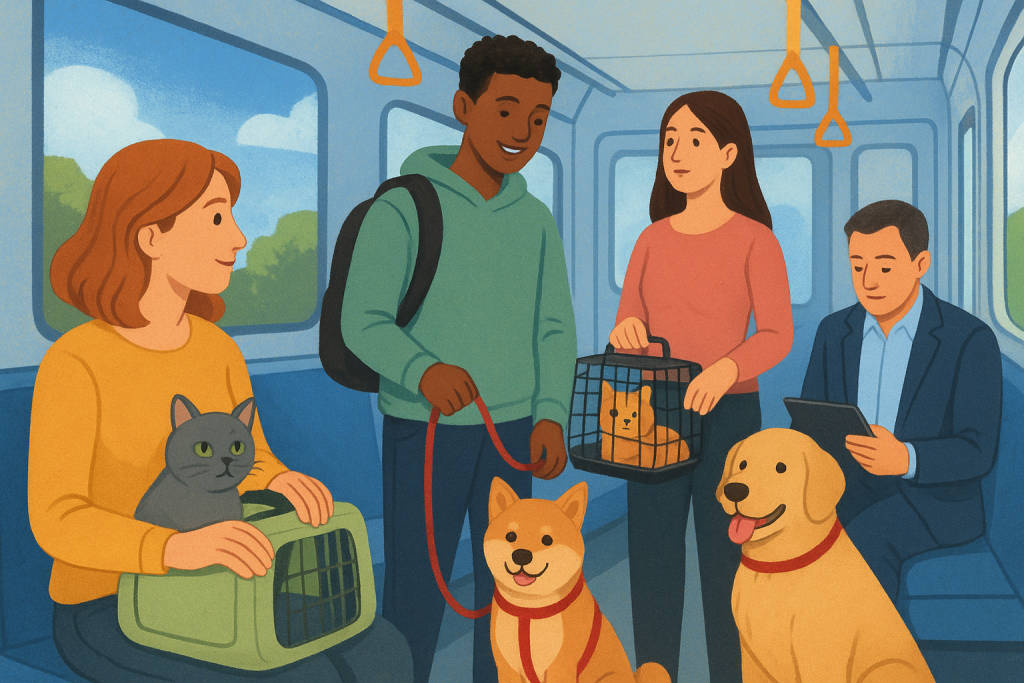
Once upon a time, the idea of a dog or cat boarding a metro seemed absurd — the domain of guide dogs and cartoons only. But step into a train in Berlin, Paris, or even Riyadh today, and you might spot a furry commuter tucked in a carrier bag or curiously sniffing the air through a muzzle. The quiet revolution of pet-friendly public transport is underway — and it’s reshaping how cities define inclusivity, empathy, and even sustainability.
A New Breed of Urban Mobility
For decades, public transport systems have been designed almost entirely around humans. Yet as pet ownership explodes — especially among young, single urban dwellers — cities are realizing that “family” now includes tails, paws, and whiskers. Germany, for example, allows dogs on subways and buses as long as they’re leashed and muzzled. In Copenhagen, small pets travel free inside carriers, while in Turkey, miniature dogs under five kilograms are permitted on ferries and trams.
This isn’t merely about convenience. It’s a cultural signal: animals are becoming full-fledged citizens of urban life. The metro, once a symbol of cold efficiency, is now evolving into a shared ecosystem that acknowledges emotional connection and companionship as part of modern well-being.
The Social Science Behind the Shift
Sociologists have noted that pet-friendly transport policies often correlate with higher levels of civic trust and emotional intelligence in a city’s population. When commuters accept a cat carrier beside them, they’re subconsciously accepting coexistence — a micro act of tolerance that ripples outward. Cities that permit animals onboard tend to show greater investment in “compassionate infrastructure”: dog parks, pet waste stations, or animal-friendly housing.
It’s also a public health story. Walking to bus stops, taking short commutes, and integrating pets into daily routines reduce owner isolation and encourage more movement. One might even argue: allowing pets on buses helps reduce carbon pawprints by cutting short car trips to the vet or park.
Barriers and the Human Factor
Not all regions are on board. In much of Asia and Australia, rules remain strict: pets are often banned from metros unless they’re service animals. The reasons vary — from hygiene concerns to overcrowded carriages — but attitudes are changing. Pilot programs in Singapore and Kuala Lumpur have already tested “pet-only carriages” or off-peak pet travel slots.
Ironically, it’s not pets who misbehave; it’s humans. Most transit complaints come from owners ignoring rules — unzipped carriers, barking dogs, fur on seats. The challenge isn’t policy but culture: how to train humans to respect shared spaces as thoughtfully as they train their pets.
The Future: Shared Journeys, Shared Hearts
Imagine a subway line where a corgi sits beside a commuter with noise-cancelling headphones, and nobody blinks. A morning ferry where cats gaze calmly at the sea through mesh carriers. This isn’t fantasy — it’s the direction progressive cities are heading.
Pet-friendly public transport isn’t just an amenity; it’s a mirror of how civilized we’ve become. When we make space for animals in our public systems, we’re also making space for kindness, patience, and the acknowledgment that life — in all its forms — deserves a seat on the ride.