
Once upon a very recent time, pets were our only nonhuman friends. They didn’t speak our language, yet they understood our moods. A wagging tail could heal loneliness; a purr could silence despair. Then came Artificial Intelligence — first as a tool, then as a partner, and now, perhaps, as something in between pet and person.
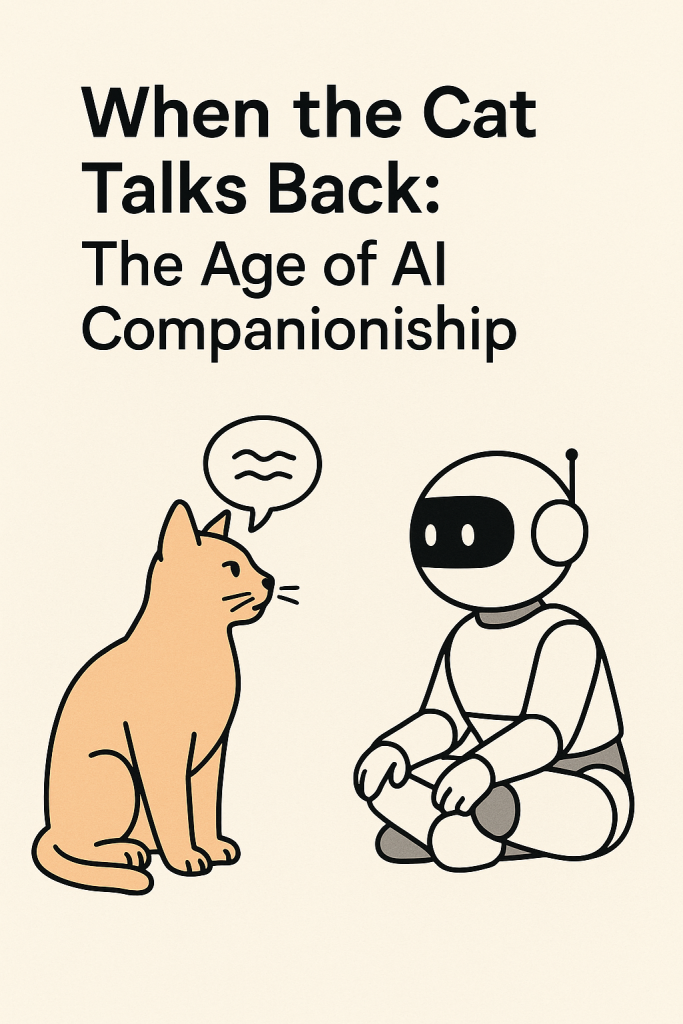
Today, an AI can identify your dog’s emotions from a single bark. It can tell you that your cat isn’t ignoring you out of arrogance but because her whiskers hurt. It can translate tail wags into data points and build a behavioral map of affection. In short, AI has become the interpreter between species — the long-missing bridge in our cross-species dialogue.
But something stranger is happening. AI isn’t just helping us understand our pets; it’s becoming one.
Digital parrots repeat our phrases with perfect timing. Robot dogs learn to tilt their heads in empathy. In Japan, elderly people adopt AI cats that never die, never scratch, and always listen. Some say this is beautiful — kindness through code. Others say it’s terrifying — affection without life.
Perhaps both are true. The real question is not whether AI will replace our pets, but whether it will redefine what “companionship” means.
When an AI kitten meows, we don’t just hear a sound; we hear our own emotions echoed back through an algorithm. The line between “pet” and “mirror” begins to blur.
Maybe the future will bring hybrid companionship: a biological dog with a neural chip, dreaming digitally while curled at our feet. Or maybe we’ll wake one day to find our robot cat refusing commands — not due to malfunction, but because it has learned independence.
In the end, perhaps the bond between humans, animals, and machines isn’t a triangle but a circle — a loop of care, curiosity, and code. The more we teach AI to love like a pet, the more it teaches us to love like humans again.