
Transporting pets by air is common, but the rules vary dramatically from one country to another. While dogs and cats can often fly in the cabin or as checked baggage in the cargo hold, each region sets its own requirements regarding documentation, age, health, and carrier specifications. The following overview summarizes how different countries manage pet travel and what travelers should be aware of before booking a flight.
United States
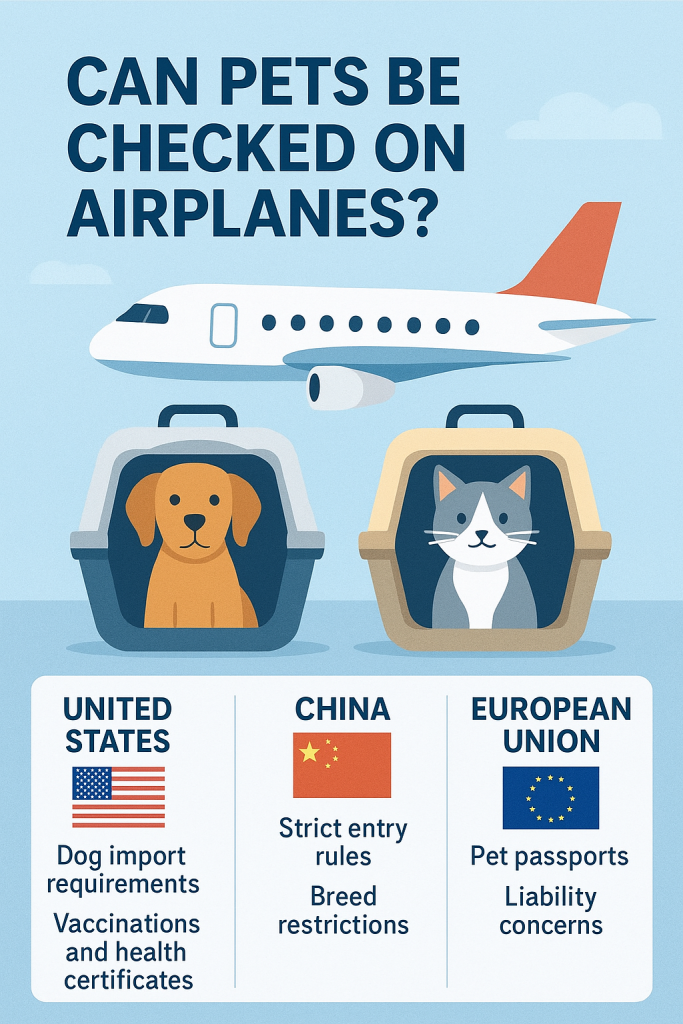
The United States allows pets to travel either in the cabin or in the cargo hold, depending on the animal’s size and the airline’s policy. However, dog importation rules have become significantly stricter.
The Centers for Disease Control and Prevention (CDC) requires all dogs entering the U.S. to be microchipped, at least six months old, and accompanied by a Dog Import Form. Dogs coming from high-rabies-risk countries must provide additional proof of vaccination and health. Airlines are responsible for creating an Air Waybill when dogs travel as cargo, and pets may be denied entry if documentation is incomplete.
China
China accepts pets on many major airlines, but only under specific conditions. Most airlines allow dogs and cats to travel in the cargo hold as checked baggage, provided the crate is sturdy, well-ventilated, and large enough for the animal to stand and turn around.
China also enforces strict entry requirements. Pets must be microchipped, vaccinated against rabies, and accompanied by official health certificates. Some breeds, especially snub-nosed dogs, are not accepted due to respiratory risks. In certain cities, pets may be subject to quarantine unless all vaccination and microchip requirements are fully met.
European Union
The European Union permits dogs and cats to travel either in the cabin or in the cargo hold, depending on airline rules. Within the EU, pets must travel with an EU Pet Passport or equivalent veterinary health certificate that confirms identification and vaccination.
A recent ruling by the European Court of Justice clarified that pets transported in the cargo hold can legally be classified as baggage under the Montreal Convention. This means airline liability for injured or lost pets may be limited unless the owner declares a higher value before travel. Although controversial, this rule affects compensation and highlights the importance of proper documentation and crate safety.
Other International Considerations
Transit rules vary widely. Some countries allow pets to remain in their carrier during layovers, while others require customs inspection if switching airlines. Airline crate standards typically follow IATA guidelines, requiring secure, rigid containers with proper ventilation.
Most airlines also limit the number of pets accepted per flight, so advance reservation is essential. Owners must ensure that all documents—microchip information, vaccination records, and health certificates—are accurate and up to date to avoid denial of boarding or entry.
Final Thoughts
While pets can travel on airplanes in many parts of the world, the process requires careful planning. Regulations in the United States, China, and the European Union each have unique requirements concerning documentation, breed restrictions, and handling procedures. Travelers should consult their airline and destination authorities well in advance and consider professional pet relocation services for complex international flights.