When the first commercial pet cloning services appeared, most people viewed them as an extravagant luxury—an emotional indulgence reserved for billionaires longing to resurrect a beloved cat or dog. But the industry has taken an unexpected turn. Today, pet cloning is no longer just about duplicating a pet’s DNA. It is subtly reshaping how humans define loyalty, memory, and even the boundaries of life itself.
A Clone Is Not a Copy—It’s a Mirror
Despite headlines that portray clones as “identical replacements,” those familiar with cloned pets notice something far stranger. A cloned dog may have the same coat pattern or ear shape, but its personality is like a shifted reflection—recognizable, yet undeniably different. Scientists attribute this to epigenetics and environment, but owners often describe it as a “parallel universe” version of their animal.
One owner said her cloned cat behaved like her original—but with “all the chaos sliders turned up.” Another described the new puppy as if it were her old dog “reborn with unfinished business.”
Whether poetic exaggeration or meaningful observation, these stories suggest that cloning creates not a duplicate, but a narrative continuation.
The Rise of the ‘Heritage Pet’
A peculiar cultural trend has emerged: multi-generation cloned lineages. Some customers re-clone the clones, creating what breeders jokingly call “heritage pets”—animals whose genomes remain frozen in time while their personalities evolve unpredictably.
Imagine a family that keeps the same DNA line of a Labrador for 150 years. Future generations might grow up believing that this dog—this specific dog—has been a permanent household spirit, a guardian threaded through the family timeline.
Is that loyalty? Tradition? Or a new form of immortality?
Cloning as an Emotional Technology
More than a scientific service, pet cloning is becoming an emotional technology—a tool that allows people to manage grief in unconventional ways.
Some choose partial cloning: preserving only specific traits, like a cat’s unique fur pattern or a dog’s snow-white eyelashes. Others request “memory continuity kits,” pairing clones with recorded scents, sounds, and habits to ease the transition.
Ironically, the industry isn’t selling pets. It’s selling psychological bridges—threads that tie past companionship to future comfort.
Ethics: Not a Wall—A Maze
Critics argue that cloning commodifies life. Supporters argue that it simply honors love. But in between those voices lies a quieter question:
What responsibilities do we owe to a being born into someone else’s memory?
Cloned pets are not resurrected ghosts; they are new creatures carrying the weight of expectation. As cloning becomes more accessible, society must consider not only the ethics of creating life, but the ethics of projecting history onto it.
A Future Where Pets Outlive Their Species
If current trends continue, it’s possible that certain beloved breeds—endangered, rare, or genetically fragile—may survive only through clones. We may see the first species that exist solely in laboratories and living rooms: animals preserved not by ecosystems, but by affection.
When that happens, the term “companion animal” might evolve from a biological category into a cultural one.
The Real Question Isn’t ‘Should We Clone Pets?’
It is this:
What does it mean to form a bond with someone who was created because a bond was once broken?
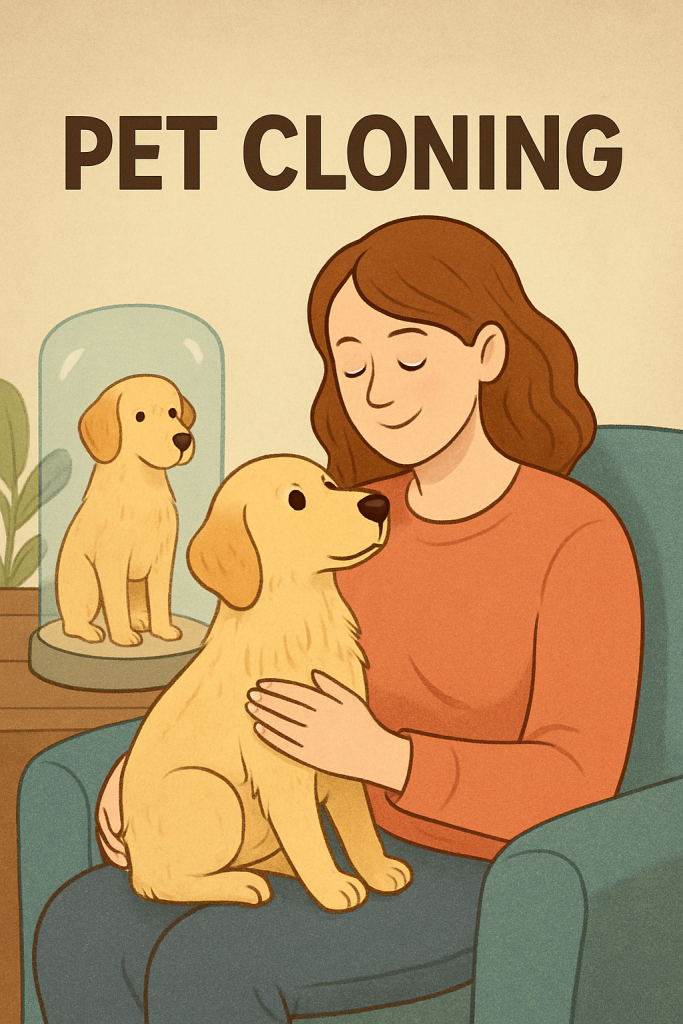
In answering it, pet cloning is forcing humanity to confront its own definitions of love, memory, and continuity. Not through philosophy books or scientific debates, but through the quiet, daily moments when a cloned pet curls up on its owner’s lap—familiar, strange, and impossibly alive.