
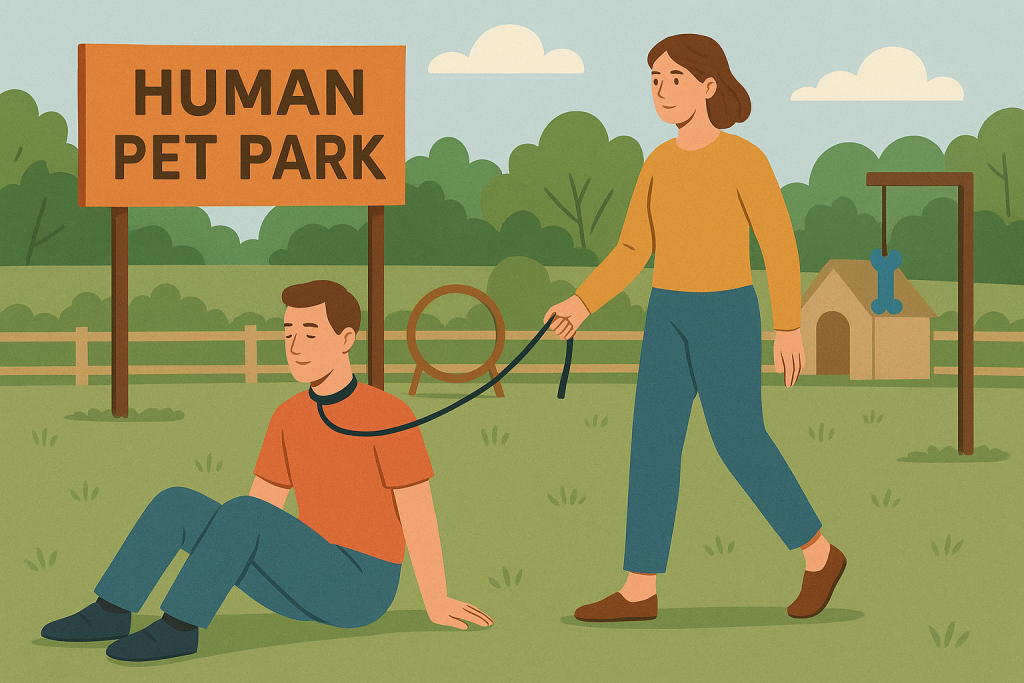
Imagine a world where the roles of humans and pets are reversed — where humans become the ones walked, trained, and cared for in specialized “Human Pet Parks.” Though it sounds like science fiction, this provocative concept is beginning to surface as a cultural experiment in empathy, psychology, and the philosophy of coexistence.
1. The Concept: A Role-Reversal Thought Experiment
The “Human Pet Park” is not about domination or absurdity — it’s a living art installation and a social experiment. The idea originated from behavioral researchers exploring empathy through simulation: what if humans experienced a day as pets, with schedules for feeding, play, and limited decision-making? The goal is to help people better understand the emotional intelligence, dependency, and trust embedded in human-animal relationships.
In these experimental parks, participants wear soft, biometric collars that track mood, heart rate, and stress levels. Volunteers acting as “caretakers” guide them through routines modeled after pet enrichment — fetching games, relaxation zones, and communication training using body language instead of words.
2. The Science Behind It: Learning Empathy Through Experience
Neuroscientists studying these simulations have found surprising results: participants often experience reduced anxiety, heightened mindfulness, and increased empathy toward animals. The structured simplicity — eat, play, rest — activates the parasympathetic nervous system, mirroring the stress-relief effect pets provide their owners.
In short, being treated like a pet reminds us of what it means to be cared for without condition. It challenges our habitual view of control and hierarchy in interspecies relationships.
3. Redefining “Intelligence” and “Freedom”
The concept also invites philosophical reflection. We often define intelligence by language, tools, or control — but what if intelligence also lies in presence, emotional attunement, and trust? Within the Human Pet Park, humans learn to “communicate” through gaze, gesture, and tone, much like dogs or cats do with us. Many participants report feeling freer without words, realizing that attention itself can be a language.
4. Ethical and Cultural Implications
Critics argue that this concept risks trivializing animal experience. Yet advocates emphasize that it’s not about imitation — it’s about perspective training. As urban societies grow more detached from nature, the Human Pet Park becomes a symbolic reminder of our shared biological needs for touch, movement, and connection. It forces us to ask: if being a “pet” feels both safe and restricted, what does that say about how we treat actual pets?
5. The Future: Empathy Labs and Beyond
Emerging versions of this idea are evolving into “Empathy Labs” — immersive spaces where visitors can step into the sensory world of animals through VR, scent simulation, and sound modulation. These experiences could influence future pet welfare policies, design of urban parks, and even therapy programs for anxiety and burnout.
In essence, the “Human Pet Park” is not a literal playground for humans on leashes — it’s a mirror held up to our species. It invites us to reimagine care, power, and coexistence. Because to truly understand our pets, perhaps we must, for a moment, become one of them.