
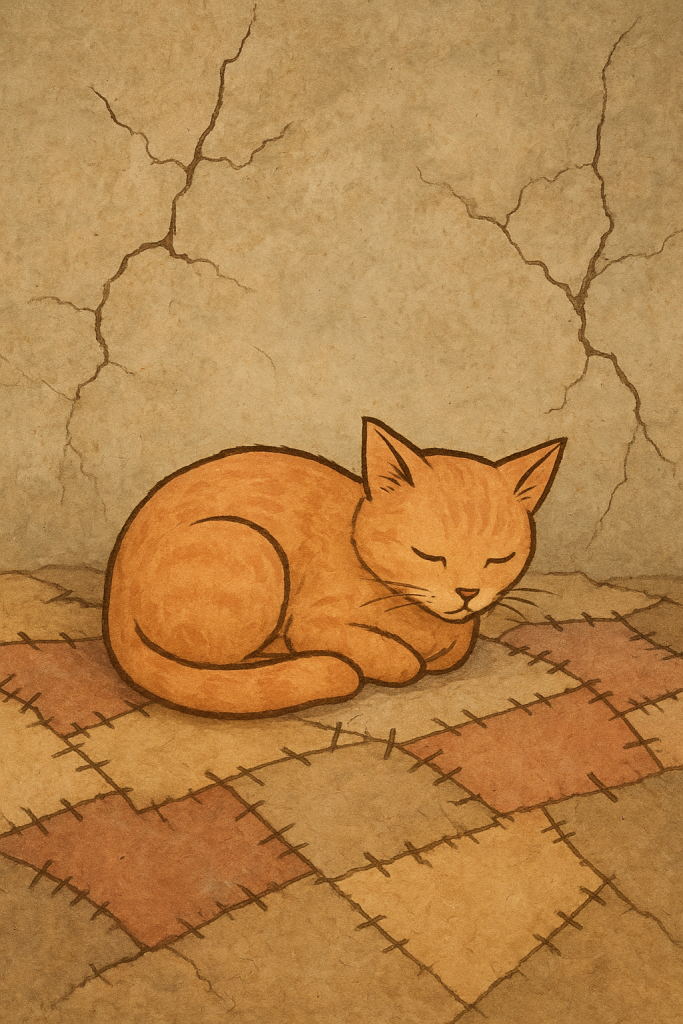
The world today often feels like a cracked mirror—fragmented, uncertain, reflecting a thousand versions of pain and confusion. We scroll through endless news of conflict, loss, and chaos. We chase after meaning in noise, seeking wholeness in a world that seems beyond repair. Yet, in a quiet room where sunlight spills across the floor, a small cat curls up and purrs. And somehow, for a brief and sacred moment, the world doesn’t feel so broken.
When people say, “The world is torn, and the cat mends it,” they speak not of miracles, but of the smallest, gentlest gestures that bring balance to a wounded existence. The cat is not a savior. It does not build or preach or argue. Its way of healing is silent—a kind of everyday grace that asks nothing but your presence.
The Language of Stillness
Cats live in stillness. They do not rush through moments; they inhabit them fully. A cat can sit for hours by a window, watching the world drift by—the flutter of a leaf, the buzz of a fly, the slow shift of light. To us, that might seem like idleness, but it is something deeper. It’s awareness. It’s peace.
When the world overwhelms us with its noise, a cat’s stillness becomes a mirror, reflecting what we’ve forgotten: how to breathe, how to listen, how to simply exist without performing. The cat mends the world by teaching us the language of slowness in a culture addicted to speed.
You can feel it in their presence. The way they curl into your lap with effortless trust, the way their rhythmic purr hums through your bones—it’s as if they tune your heartbeat back to a calmer rhythm. Their quiet companionship repairs what chaos has undone.
The Art of Small Repairs
The cat doesn’t fix the world in grand gestures; it sews tiny stitches where life has torn. When you come home after a long day—defeated, drained, wordless—the cat greets you not with questions, but with understanding. It rubs against your leg, leaves traces of warmth where coldness once lived.
In that small exchange, something shifts. You remember that connection doesn’t need explanation. That love, in its purest form, is simply presence.
Cats mend the world in a thousand invisible ways:
- By teaching us tenderness when we stroke their fur.
- By reminding us that trust is earned, not demanded.
- By showing that solitude and loneliness are not the same thing.
When a cat sits beside you in silence, it’s not absence—it’s quiet solidarity. It’s a reminder that comfort doesn’t need conversation; it only needs company.
Fragments of Wholeness
There’s a Japanese art form called kintsugi—the practice of repairing broken pottery with gold. The cracks are not hidden but highlighted, turning the object’s history into beauty. Cats live by a similar philosophy. They don’t erase brokenness; they rest within it, transforming it through warmth and patience.
A cat lying in a cardboard box, finding joy in something discarded, becomes a living metaphor for resilience. Where humans see imperfection, the cat sees possibility. It doesn’t wait for the world to be perfect to find comfort—it creates comfort within the imperfect.
When the world feels like it’s falling apart, that simple act of adaptation becomes a quiet rebellion. It’s as if the cat is saying, “Yes, things break. But you can still rest. You can still love. You can still purr.”
The Silent Teacher
Cats have a way of teaching without teaching. They don’t demand your attention, yet they earn it effortlessly. Their lessons are hidden in daily rituals—the stretch after a nap, the patient observation before a leap, the unapologetic demand for affection when they need it.
They show us boundaries, self-care, and the beauty of independence. They remind us that it’s okay to withdraw, to find peace in solitude, to protect one’s energy. In a society that glorifies constant availability, the cat teaches sacred stillness.
And yet, when they do choose closeness, it feels like a gift. That gentle paw on your arm, that soft purr in the night—it feels like grace. Like the universe whispering through fur and breath: “You’re still loved, even when everything feels lost.”
Healing Through Softness
People often mistake softness for weakness. But cats, with all their grace, are the embodiment of gentle strength. Their purrs can calm a racing heart; their presence can steady trembling hands. Science tells us that the frequency of a cat’s purr can aid in healing bones and tissues. Emotionally, that sound feels like a lullaby for the soul—a vibration of safety and continuity in an uncertain world.
When the world seems cruel and fragmented, cats remind us that tenderness is a form of resistance. To care, to nurture, to slow down—these are radical acts in times of chaos.
A cat doesn’t fix what’s broken by force. It does so by being wholly, authentically itself. And perhaps that’s the deepest kind of healing—to remind us that authenticity and peace are not luxuries, but necessities.
A Patchwork of Connection
Every person who has ever loved a cat carries small, invisible stitches from their time together. The first night the cat slept on your chest. The day it brought you a leaf as a gift. The way it blinked slowly, telling you in its secret language, “I trust you.”
Each of these moments becomes thread—fine, golden, delicate—that repairs something within you. Over time, you realize that the world is still torn, but your heart is not. Or at least, not in the same way.
Cats remind us that life isn’t about achieving a flawless whole. It’s about creating a patchwork of meaning, held together by love, habit, and shared quiet moments. The stitches don’t erase the cracks; they transform them into art.
The Cat and the Human Heart
There’s a peculiar harmony between human fragility and feline calm. Perhaps it’s because cats don’t require us to be strong. They accept us when we are exhausted, when the world feels too big, when we’ve forgotten how to smile. They sit beside us in silence, and in that silence, they hold us together.
If you’ve ever cried in the dark and felt a cat climb onto your lap, you’ve felt it—the wordless healing that no therapist or medicine could replicate. It’s not that the cat understands your sadness, but that it chooses to share your space within it. That kind of empathy doesn’t ask to solve; it asks to accompany.
And that is how the cat mends the world—not through logic or ambition, but through quiet presence, moment by moment, heartbeat by heartbeat.
The Soft Revolution
In a world obsessed with noise, cats are revolutionaries of silence. In a culture of busyness, they are prophets of rest. Their existence is a soft rebellion against everything that demands we move faster, harder, louder.
To live like a cat—to sleep in the sun, to love without noise, to find joy in small things—is to reclaim a piece of our lost humanity. It’s to accept that the world may always be imperfect, but we can still build corners of peace within it.
The Golden Thread
Maybe the cat doesn’t literally mend the torn world. Maybe it simply reminds us how to hold it. The stitches it sews are invisible but real: compassion, patience, gentleness, warmth.
So when the world feels rough and torn apart, look to the cat resting in a patch of sunlight. Watch how it blinks slowly, stretches, and curls into itself as if the universe were still safe. In that small act, the cat repairs a piece of reality.
Because mending doesn’t always mean changing the world. Sometimes, it just means keeping the warmth alive within it.
And perhaps that’s enough—for now.